


How Often Does an Owners Corporation Need a Strata Insurance Valuation in NSW?
Introduction
Ask ten strata committee members in Parramatta or Penrith how often their building needs an insurance valuation and nine will tell you “every five years, it’s the law.” It’s the most repeated line in strata — and in New South Wales, it hasn’t been the law for a decade.
That surprises people, and it should, because the practical answer hasn’t changed much: most schemes still need property valuation services across Western Sydney every few years to keep their assessed figures reasonably current. The reasoning behind it has just shifted from “the Act says so” to “the Act makes you liable if you get it wrong.”
This article sets out what the Strata Schemes Management Act 2015 actually requires, why the old five-year rule disappeared, how often a valuation genuinely makes sense in a Western Sydney building, and what happens to owners when the sum insured turns out to be short.
Summary
New South Wales repealed its mandatory five-yearly strata insurance valuation requirement in 2015. There is now no clause in the Strata Schemes Management Act 2015 telling an owners corporation how often to obtain one.
What the Act does say is that the owners corporation must insure the building under a damage policy, and the building must be insured for at least the amount worked out under the regulations — covering full replacement or reinstatement to a condition no worse than when new, plus demolition, debris removal and professional fees. Working out that number without a valuation is guesswork.
In practice, most schemes and insurers land on a full inspection-based valuation every three years, with a desktop update in between. The trigger isn’t the calendar so much as change: major capital works, a new lift or solar array, defect rectification, remediated cladding, or a stretch of steep construction cost growth all age a valuation faster than time alone.
If the sum insured falls short and the building burns down, the gap doesn’t disappear. It lands on lot owners as a special levy — and committee members who ignored the issue can find themselves personally on the hook for the decision. Note that the rules differ interstate: Victoria and Queensland both retain statutory valuation intervals, so an investor with lots in more than one state is dealing with two different sets of obligations.
What Strata Valuers in Western Sydney Do for an Owners Corporation
A strata insurance valuation answers one question: what would it cost, today, to rebuild this building from the ground up if it were destroyed?
That’s it. It isn’t a market appraisal, it isn’t what the units would sell for, and it has nothing to do with what owners paid.
Reinstatement cost, not market value
This is where most confusion starts. Say you’ve got a 1980s red-brick walk-up block of 12 units in Merrylands. The units might sell for $650,000 each, putting the “market value” of the scheme somewhere around $7.8 million. But a good chunk of that figure is land value — and land doesn’t burn down.
The insurance figure works the other way. It ignores land entirely and prices the physical rebuild: demolition of what’s left, carting the rubble away, new slab, new frame, new roof, new services, plus the architects, engineers and certifiers you’d need to get the job approved and finished.
Those two numbers can diverge wildly. In a Western Sydney block where the land is doing the heavy lifting, the rebuild figure may sit well below market value. In a newer building with lifts, basement carparking, fire systems and a pool, the rebuild figure can sit well above what owners expect.
What has to sit inside the sum insured
Under section 161 of the Strata Schemes Management Act 2015, a damage policy has to provide for the building to be rebuilt or replaced so that every part is in a condition no worse and no less extensive than when it was new. It also has to cover the cost of removing debris and the fees of architects and other professionals whose services are needed.
So a properly built figure accounts for:
- Demolition, site clean-up and disposal of what’s left standing
- Full rebuild of the structure and common property to current standards
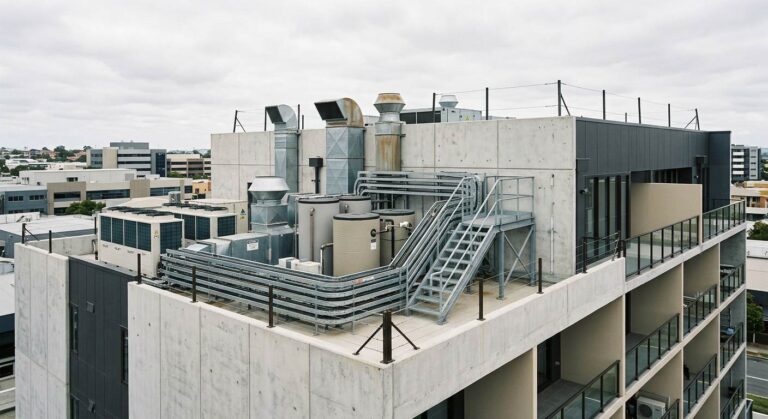
- Common property fit-out — lifts, fire services, intercoms, pumps, roller doors, EV chargers, solar
- Landscaping, fencing, driveways, retaining walls and pergolas on common property
- Professional fees: architect, engineer, planner, certifier, project manager
- Council and statutory approval costs
- Escalation — the cost movement between today and the point the rebuild is finished
- Loss of rent or temporary accommodation, where the policy provides for it
That last two catch people out. A rebuild isn’t instant. Between the fire, the insurance assessment, the DA, the tender and the build, you can easily be three years down the track — and construction costs won’t have stood still.
Who’s qualified to do one
NSW deregulated valuer registration in 2015, so there’s no longer a state register of valuers to point to. In practice, owners corporations should be looking for a Certified Practising Valuer (CPV) accredited through the Australian Property Institute, or a quantity surveyor with genuine strata experience. Insurers and brokers will generally want to see who prepared the report and what they’re accredited under.
Be wary of a “valuation” that’s really an online replacement cost calculator with a letterhead on it. It’ll be cheap, and it won’t hold up when a claim gets scrutinised.
Does NSW Law Require a Strata Insurance Valuation Every Five Years?
Short answer: no. Not anymore.
The rule that used to exist
Under the old Strata Schemes Management Act 1996, section 85 required owners corporations to obtain an insurance valuation at least every five years. Section 83 tied the minimum sum insured to the last valuation obtained.
Both provisions were repealed on 5 November 2015 by the Regulatory Reform and Other Legislation Repeals Act 2015, as part of the deregulation of the valuation profession in NSW. When the Strata Schemes Management Act 2015 commenced, those clauses simply weren’t carried across.
Part 9 of the current Act runs from sections 160 to 175 and covers insurance in detail — damage policies, public liability, insurance claims, tribunal orders. Nowhere in it is there a section prescribing how often a valuation must be obtained.
What the Act does require
The obligations that survived are the ones that matter:
| Provision | What it requires |
| Section 160 | The owners corporation must insure the building and keep it insured under a damage policy |
| Section 161 | The building must be insured for at least the amount determined under the regulations, and the policy must provide for rebuilding to “as new” condition, debris removal and professional fees |
| Section 164 | Other mandatory cover, including public liability of at least $10 million |
The Strata Schemes Management Regulation 2016 sets out how the minimum amount is calculated: required estimated costs at policy commencement, expected increases during the following 24 months, and applicable taxes, fees and charges. It’s a prescribed method, not a vibe — and it’s difficult to satisfy honestly without a valuer having actually looked at the building.
Why “no set frequency” doesn’t mean “no obligation”
This is the part that gets lost. Removing the five-year clause didn’t remove the duty to insure adequately. It removed the safe harbour.
Under the old rule, a committee could point to a four-year-old report and say “we complied.” Now there’s no such shield. The obligation is to keep the building insured for at least the amount the regulations require — an ongoing test, measured at the moment of the claim, not at the moment of the last inspection.
Several other pressures fill the gap:
- Insurers and brokers. Most will ask when the last valuation was done, and some will decline to offer full reinstatement cover, or apply conditions, if the figure is stale.
- Strata managing agents. A managing agent exercising due care will recommend a valuation at intervals and minute the recommendation. If the committee declines, that’s on the record.
- Section 182 records inspections. Buyers’ strata report inspectors routinely note the date of the last insurance valuation. An old date is a red flag in a pre-purchase report and it can affect sale prices across the scheme.
- Owner complaints and NCAT. A lot owner who believes the scheme is underinsured has avenues, and “no one told us to” is a poor answer.
The interstate picture
If you hold lots in more than one state, don’t assume the NSW position applies elsewhere:
- Victoria — section 65 of the Owners Corporations Act 2006 requires an owners corporation to obtain a valuation of the buildings it must insure at least every five years, with tier five owners corporations (broadly, two-lot subdivisions and services-only schemes) exempt.
- Queensland — bodies corporate under the Body Corporate and Community Management Act 1997 must insure for full replacement value, and the regulation modules require a valuation to be obtained at prescribed intervals, generally at least every five years.
- NSW — no prescribed interval, but the same underlying duty to be adequately insured.
Same building type, same insurer, different statutory obligations. Worth knowing if you’re a committee member for a scheme in Blacktown and an investor in a Brisbane block.
So How Often Should You Actually Get One?
Here’s where practice matters more than legislation.
The common approach across the industry — and the one most brokers will nudge you toward — is a full valuation with a physical inspection every three years, supported by a desktop update in the intervening years.
Three years rather than five reflects something simple: construction costs in NSW have moved sharply over recent years, and a figure set in a calmer market can be materially short by the time it’s tested. Five-year cycles were designed for an era of steadier cost growth.
A desktop update between full valuations is a lighter piece of work. The valuer takes the last inspection-based report and adjusts it for cost movement and any changes the strata manager reports. It’s cheaper, it’s quick, and it keeps the sum insured tracking reality without a full site visit every year.
Events that should trigger a valuation regardless of the calendar
Time isn’t the only thing that dates a report. Get a fresh valuation — or at least a desktop review — when any of these happen:
- Major capital works. A new roof, re-clad façade, window replacement across the block, or a full common property refurbishment changes the rebuild cost.
- New plant or infrastructure. Lift upgrades, solar arrays, EV charging infrastructure, new pumps or fire systems all add to what would need replacing.
- Cladding rectification. If combustible cladding has been removed and replaced under remediation, the replacement system is usually a different cost base entirely.
- Defect rectification after a building bond claim. Same principle — what’s there now isn’t what was there before.
- A change in the use of lots. Residential lots converted to commercial use, or a scheme with a growing number of short-term letting arrangements, can shift both risk and rebuild specification.
- Extensions or additions. A new common property structure — carport roofing, a garbage room, an awning — is often never reported to the insurer.
- Sharp movement in construction costs. If you’re two years into a three-year cycle and materials costs have run hard, bring it forward.
- A partial claim. After a fire, storm or water damage event, the rebuilt portion may be to a different standard than the original.
A rough guide by building type
| Building type | Suggested approach |
| Small walk-up block, no lift, stable condition | Full valuation every 3 years; desktop update in between |
| Mid-rise with lift, basement parking, fire services | Full valuation every 3 years; annual desktop update |
| High-rise with pool, gym, extensive common property | Full valuation every 2–3 years; annual desktop update |
| Mixed-use (retail below, residential above) | Every 2–3 years — fit-out and use changes drive movement |
| Scheme mid-way through major works or remediation | Fresh valuation on completion, regardless of cycle |
These are practical suggestions, not legal requirements. Your broker or insurer may have their own expectations, and those are worth asking about before renewal.
What Underinsurance Actually Costs Owners
It’s easy to treat the sum insured as an abstract number on a certificate of currency. It stops being abstract the day something goes wrong.
Suppose a 24-unit block in St Marys is insured for $9 million. A serious fire destroys the building. The actual cost to demolish, clear the site, redesign to current BCA standards, rebuild and cover professional fees comes to $12.5 million.
The insurer pays up to the sum insured. The $3.5 million gap doesn’t get absorbed by anyone else. It falls back on the owners corporation, which means a special levy — roughly $145,000 per lot in that example, apportioned by unit entitlement.
Some owners can’t fund that. Levies go unpaid, recovery action follows, and the rebuild stalls while owners are still paying mortgages on buildings that no longer exist.
A few things worth understanding:
- Check the policy for a co-insurance or average clause. Some policies reduce the payout proportionally when a building is underinsured, even on a partial claim. That means a stale valuation can bite you on a $200,000 water damage claim, not just on a total loss.
- Current building standards apply to the rebuild, not 1985 standards. Fire separation, accessibility, energy efficiency, waterproofing — a rebuild has to meet today’s requirements. That’s frequently more expensive than the original construction, and a valuation prepared by someone who doesn’t understand strata will miss it.
- Committee members carry responsibility for the decision. If a valuation was recommended, minuted and voted down, the paper trail exists.
What Makes Western Sydney Buildings Different
Rebuild costs aren’t uniform across greater Sydney, and a generic figure pulled from a metropolitan average won’t reflect a specific site.
Weather and site risk
Western Sydney sits in a genuine hail corridor, and severe storm events have repeatedly caused significant roof, window and vehicle damage across the region. Parts of the Hawkesbury-Nepean floodplain carry flood exposure that affects both premiums and the practical realities of rebuilding.
None of this changes the reinstatement figure directly, but it does change how likely you are to test it.
Rapid change across the region
Parramatta, Liverpool, Blacktown, Penrith and Campbelltown have all seen substantial strata development, and the building stock now ranges from 1970s walk-ups to towers with basement parking and shared amenities. Two blocks in the same suburb can have completely different rebuild profiles.
Site access and construction logistics
A rebuild on a tight infill site with limited street access, overhead power and neighbours on both boundaries costs more than a rebuild on an open suburban lot. Craneage, scaffolding, traffic management and staged demolition all get priced. A valuer who has actually stood on the site accounts for this. A desktop-only figure generally doesn’t.
Cladding and defect remediation
Buildings caught up in combustible cladding remediation, or with rectification works completed under the building bond scheme, need their valuations refreshed once works are finished. The replacement system and the compliance pathway are usually a different cost base from what was originally installed.
How the Valuation Process Works
For most schemes it’s a straightforward exercise, and preparing for a strata valuation with the right plans, insurance records and details of recent works helps the valuer build a more reliable assessment.
What you’ll be asked for
- The registered strata plan
- Original architectural or construction plans, if the scheme still has them
- Records of any major capital works, upgrades or additions
- The current certificate of currency and policy schedule
- Access to common property, and ideally one or two representative lots
- Details of any remediation work completed
What happens on site
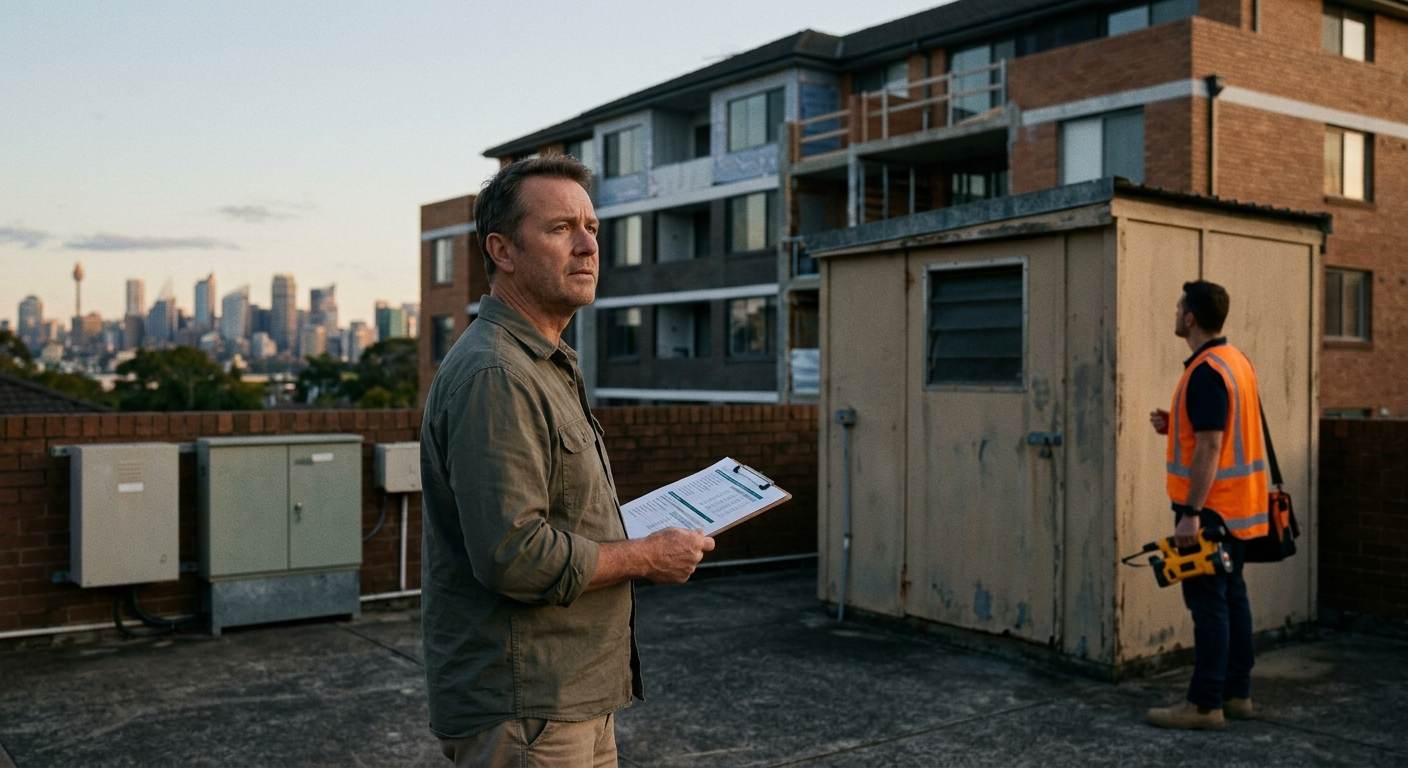
The valuer inspects common property, the external envelope, plant and services, and enough of the lots to understand the internal fit-out standard. In a large scheme, they’ll typically inspect a sample rather than every unit and rely on the strata plan and original documentation for the rest.
What you get back
A written report setting out the assessed replacement cost, the assumptions behind it, what’s been included and excluded, the date of inspection and the basis of assessment. That report goes to the broker or insurer at renewal, sits in the scheme’s records, and should be tabled at the next general meeting.
Turnaround is usually a week or two, depending on scheme size and access.
Common Misconceptions Worth Clearing Up
“Our insurer already gave us a figure.”
Insurers usually accept whatever sum insured you nominate. The number on your certificate is generally the one someone in the scheme supplied, possibly years ago and possibly indexed forward with a generic factor. It isn’t independent advice.
“We indexed it by CPI each year, so it’s current.”
CPI tracks the cost of a household basket of goods, not construction. Building costs and consumer prices move at different rates. Indexation is better than nothing, but it isn’t a substitute for a valuation.
“We just did a capital works fund forecast, that covers it.”
Different exercise entirely. A capital works fund (formerly sinking fund) forecast plans the progressive replacement of components over ten years. An insurance valuation prices a total loss today. Neither can stand in for the other.
“Our building is heritage-listed, so it’s the same as any other rebuild.”
It isn’t. Heritage constraints can require like-for-like materials, specialist trades and a longer approval process — all of which push the reinstatement cost up, sometimes considerably.
“It’s only a small scheme, so it doesn’t really matter.”
A six-lot block still has to be rebuilt in full. And with fewer owners to share a shortfall, a per-lot special levy in a small scheme is often worse.
FAQs
Is a strata insurance valuation a legal requirement in NSW?
Insuring the building is. Obtaining a valuation isn’t specifically mandated by the Strata Schemes Management Act 2015. But the Act requires the building to be insured for at least the amount worked out under the regulations, and a valuation is the practical way to establish and evidence that figure.
How much does a strata insurance valuation cost?
It varies with scheme size, building complexity and access. A small walk-up block sits at the lower end; a high-rise with a pool, gym and multi-level basement is considerably more. Get a quote based on your actual strata plan rather than a per-lot rule of thumb — and remember it’s a common expense paid from the administrative fund.
What’s the difference between a market valuation and an insurance valuation?
A market valuation estimates what the property would sell for, including land. An insurance valuation estimates the cost to rebuild the structure, excluding land. They answer different questions and shouldn’t be used interchangeably.
Can the strata committee decide not to get one?
It can, and the decision should be minuted. But the obligation to be adequately insured continues, and a documented decision to skip a recommended valuation is exactly the sort of thing that gets examined after a claim falls short.
Do we need a valuation if the building is brand new?
Usually within the first year or two, yes. The developer’s construction contract price isn’t the same as the reinstatement cost — it excludes demolition, debris removal, escalation and professional fees on a rebuild, and it doesn’t account for the compliance requirements that would apply to a replacement building.
Does the valuation need to go to a general meeting?
Good practice is to table it at the next general meeting so owners can see the basis for the sum insured. Some schemes also include the valuation date in their annual insurance disclosure to owners.
We’re a two-lot scheme with detached buildings. Does any of this apply?
Possibly not in the same way. Section 160 doesn’t apply to a two-lot scheme where the owners corporation resolves unanimously, the buildings are physically detached and no part of the building sits outside those lots. Worth getting advice specific to your plan.
Who can carry out a strata insurance valuation in NSW?
There’s no state registration for valuers in NSW since 2015. Look for a Certified Practising Valuer accredited through the Australian Property Institute, or a quantity surveyor with strata experience, and check that your insurer or broker will accept the report.
Conclusion
NSW no longer prescribes how often an owners corporation must obtain a strata insurance valuation, but the duty to insure the building adequately hasn’t shifted. A three-yearly inspection-based valuation, with desktop updates in between and a fresh assessment after major works, keeps the sum insured honest.
The cost of getting it right is modest. The cost of getting it wrong lands on owners as a special levy.
Need a hand with your scheme’s valuation?
If your committee isn’t sure when your building was last assessed — or whether the current sum insured still stacks up — a conversation with an experienced valuer is a sensible starting point.
Western Sydney Valuations prepares independent strata and common property valuations for owners corporations across the region, and is happy to talk through what your scheme actually needs before you commit to anything.
Phone: +61 438 080 786